Smart switches and electronic wall plates: the Smart Home guide
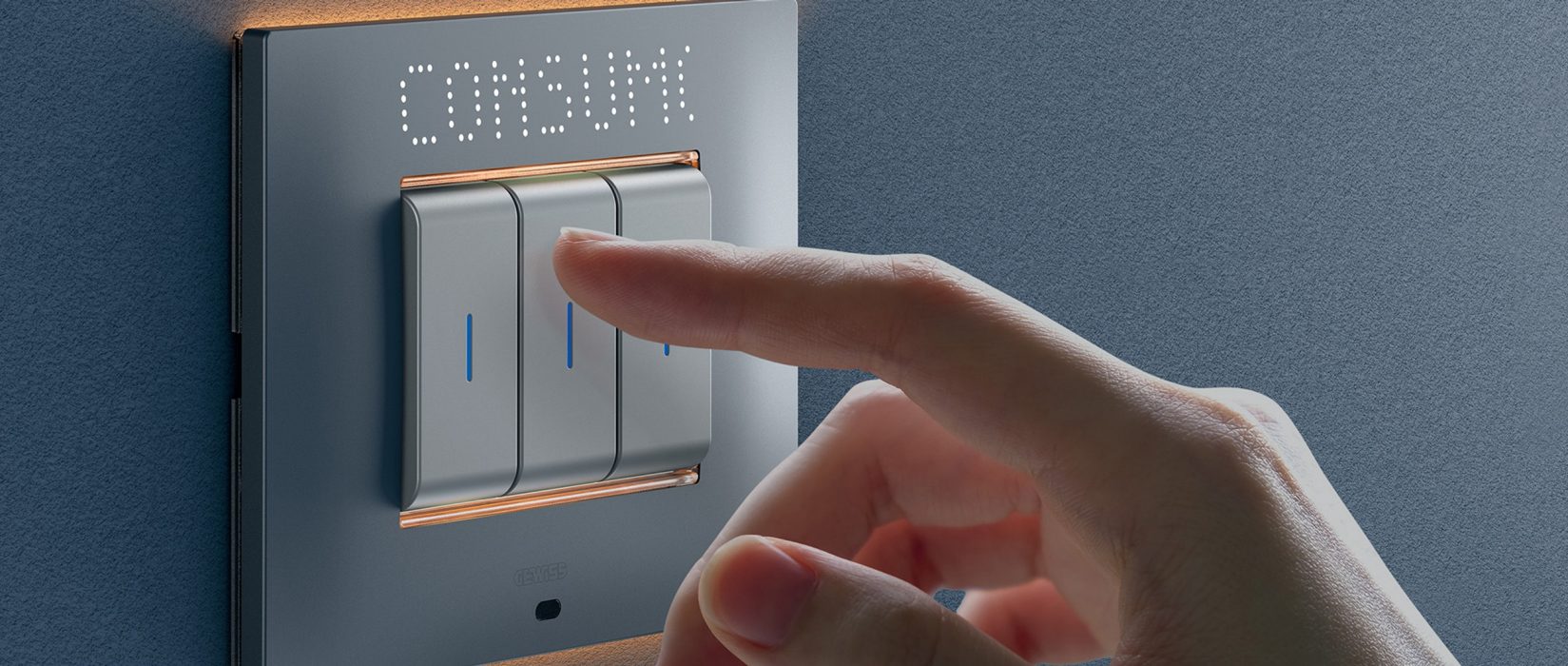
The smart switches and electronic wall plates are an integral element for Smart Home management and an advanced experience. Transforming the home with a digital and wireless approach unites energy savings with refined aesthetics and a lifestyle experience customised to requirements.
How smart switches work
The Smart Home’s centralised automation control system sends and receives signals from the smart switch, which opens or closes the flow of current along a specific line, thus activating the associated loads. Data transmission is guaranteed by an integrated module that communicates using various network frequencies, while a stylish interface serves as the housing for the local control unit, integrating perfectly with a wide variety of interior design styles.
The adoption of modern electronic plates enables the switching on and off of lighting fixtures, set up of customised scenarios, management of blind and shutter movements, and activation of security systems.
The user interacts with the components either by touching an electric touch plate (like the EGO SMART plate from the ChoruSmart series) or remotely: GEWISS smart switches can also be controlled via app and voice assistants, for a fluid and complete experience.
Comparison of communication protocols
The stability and potential of a Smart Building are determined by the communication protocols used, the main ones being:
- Wi-Fi: does not require a central coordinator and connects to the home modem. Ideal for devices that transmit large amounts of data (such as cameras), but it consumes a great deal of energy and risks congesting frequencies if there are many connected nodes;
- Bluetooth (BLE): suitable for limiting the consumption of battery-powered sensors, it guarantees immediate communication with phones. It has a reduced geometric range and requires a bridge interface for control outside the home;
- Zigbee protocol: developed specifically for the Smart Home, the ZigBee protocol works thanks to a mesh structure in which every element relays the signal, increasing coverage. It is a certified protocol adopted by numerous manufacturers that drastically reduces energy consumption and makes the infrastructure scalable and ready for future expansions.
- Z-Wave: functions similarly to ZigBee but uses different radio frequencies, eliminating the risks of interference with other signals. The average cost of the modules is higher, but it offers a wider range of action.
Functions controlled by smart switches
The switches connected to a smart electrical system can control various devices in the home, creating integrations that improve efficiency, security, and the living experience.
Lighting
With a smart dimmer, for example, you can do much more than simply switch on or off lighting. Users can vary light intensity and change the colour temperature; by defining scenarios you can switch off all the lighting with a single touch when leaving the home or switch it on automatically on re-entry.
Windows and door automations
A smart actuator for electronic roller shutters allows you to coordinate the opening and closing of blinds and shutters based on fixed schedules or sunrise and sunset cycles. Motorised window and door systems, including transom window systems positioned high up, can be integrated with weather sensors for closure in the event of rain. Furthermore, the use of wireless relays enables the remote operation of driveway gates and garage doors.
Home Appliances
Load monitoring via a connected actuator permits smart monitoring of electricity consumption and improvement of energy efficiency. In addition, being able to view consumption data in detail via the user interface, you can identify the devices drawing power in stand-by mode and cut off their power supply when they are not in use. Remote programming also makes it possible to switch on appliances during the most cost-effective time slots or when a photovoltaic system is generating the most energy
Climate Control
Dedicated apps also enable the management of indoor temperature from anywhere, and thanks to automated routines, air-conditioning systems can be turned off at night or while the occupants are away. Many systems also leverage smartphone geolocation to activate the heating just as occupants are approaching home. Finally, consumption data helps to optimise energy costs.
Security
Smart switches contribute to the prevention of domestic incidents and break-in attempts – thanks to presence simulation scenarios that activate lights at planned intervals to deter burglars – and to real-time status verification of the various devices.
The modules interface with alarm systems and motion sensors allowing you to program soft night lights along hallways, facilitating mobility for elderly people or those with different motor abilities via the use of voice commands.
How to make a system smart without any building work
Updating a traditional system does not necessarily require invasive structural interventions. A system can be made smart without any building work, preserving the design of the rooms while simultaneously introducing advanced digital functions.
To turn a home’s switches into smart switches while maintaining the old components, you can use devices that communicate wirelessly, and do not require a direct power supply thanks to an energy harvesting system. These batteryless devices can be positioned anywhere on walls or furniture and can be easily moved if furniture is rearranged or there’s a change in the household’s needs.
For a smart upgrade to appliances, smart plugs provide a functional solution; these translate signals between traditional wall outlets and appliances and send them wirelessly. Similarly, replacing traditional light sources with connected lamps completes the smart transition of the environment.
Installation within a connected electrical system
The assembly and commissioning of a connected electrical system follow the standard operating procedures adopted by installers to ensure the safety of the operator and correct function of the system:
- sectioning the system, cutting off the main power supply to work in the absence of voltage;
- removal of the old mechanical module and wiring of the new smart control plate;
- housing for a smart device inside the junction box or at the base of the flush-mounted wall box;
- configuration of the gateway (where necessary), associating the device with the home Wi-Fi network using the dedicated mobile application, to map all nodes.
The user can choose the desired level of automation: a basic infrastructure includes control of switches for electronic shutters, lights, and heating; an advanced level requires the use of switches and cover plates for more advanced systems, connected to thermostats, environmental sensors, and alarm control units.
FAQ
A mechanical switch physically interrupts the flow of current. Smart electronic switches, on the other hand, incorporate electronic circuit boards and radio receiver modules, and are integrated into plates with touch sensors. This allows them to send digital impulses to the system, enabling remote control, timed load variation, and the creation of complex scenarios.
Yes. Through features dedicated to the smart control of electrical consumption, these devices analyse real-time consumption of individual connected appliances. The data is processed by applications to identify inefficiencies, eliminate latent consumption of devices in stand-by, and schedule activation during off-peak rate hours.
Almost all modern devices support native integration with the main voice assistants on the market. Through hub configuration or the management application, the connected switch can be associated with Google Home, Amazon Alexa, or Apple HomeKit smart home profiles, enabling activation of commands and scenarios via simple voice instructions.
Discover the Related Range
Trending Topics
Related articles




Show other categories


You can enter the Gewiss world by consulting the sites available for each country, differentiated by language, services, and catalogue offerings
Choose your country


Check your country
You are browsing the International site but it seems that you are in {{country}}. Do you want to update your country?

Yes, go to the website for {{country}}

No, stay on the International site